2/20/2011

The origin of Egypt's name

(Map of Egypt )

Written By : Nermin Sami Abd El Fattah.

Original article: http://www.touregypt.net/featurestories/kmt.htm

21-10-2002

Why Egypt is called "Egypt"-"Misr"?
Over the millenniums, Egypt has had many names in many different languages. Today, its official name is Jumhuriyah Misr Al-Arabiyah, which means in English the “Arab Republic of Egypt”.

The Egyptians themselves refer to Egypt as ‘Misr’, though this can also be
a name for the city of Cairo.

Interestingly, it’s common among Egyptians who live outside of Cairo to refer to the city itself by saying ‘Misr’, in a certain respect; this is a custom that dates to the earliest times of ancient Egypt.

The different names of Egypt can be divided into 3 main groups, according to their chronology:-

The 1st group (Dating back to the Old Kingdom) :-


In the early period of the Egyptian history, during the Old Kingdom, Egypt was referred to as ‘Kemet’ (Kermit), or simply ‘Kmt’, which means "the Black land" or "fertile land".

-And the ancient Egyptians had named themselves "remetch en Kemet", which means the "People of the Black Land". The term refers to the rich soil, found in the Nile Valley and Delta.

-Also they used the word “Deshret", or "desert’, which refers to the "Red Land", or 'Deserts’
of which Egypt is mostly comprised.

2nd group :( Dating back to The New kingdom):-


Later, the ancient Egyptians referred to their country as (Ht-ka-Ptah) or (Hout-ak Ptah) , which means "Temple for Ka of Ptah", or more properly, "The House of the Ka of Ptah" ; Ptah was one of Egypt's earliest Gods. As in modern Egypt, this was the name for the administrative centre of Egypt (Memphis), as well as the name of the country as a whole.

-Then during the 9th century B.C., the ancient Greek poet writer ‘Homer’ has mentioned for the first time the name of ‘Aegyptus’ in one of his epics ‘Odyessey’; which explains that the word of ‘Egypt’ derives from the Greek mythological figure ‘Aegyptus’ who ruled over Egypt, and was the son of the king Belus ( the son of Poseidon )and Queen Anchinoe .
He had a twin brother called Danaus,the two brothers had 100 children- Aegyptus had 50 sons ,and Danaus had 50 daughters.


The brothers were on bad terms; and to make peace, Aegyptus wanted his 50 sons to marry Danaus's 50 daughters, the Danaids' daughters refused, and Together with their father, they fled to Argos where Danaus became a king.

Aegyptus and his 50 sons followed them there, at which point Danaus decided to let the marriages happen. On the day of the wedding Danaus gave each of his daughters a knife and instructed all of them to kill their new husbands in their wedding beds.


All but one were successful - the disobedient daughter; Hypermnestra; was put in prison by her father for disobeying his order, but later on she was rescued by her husband.The Greek Goddess Artemis killed the Danaids' for their crime and they were sent to the underworld, punished forever by a cruel penalty.

-During the Ptolemaic Period, the ancient Greeks have referred to Egypt with the word ‘Aegyptus’ that was originally derived from ‘Ht-Ka-Ptah’.The ancient Greek was having a difficulty in pronouncing the letter ‘H’ in ‘Ht-Ka-Ptah’ ,on account of that they omitted the letter ‘H’ and altered the ‘K’ with the letter ‘G’, moreover they added ‘os’ as an ending to this word.

This illustrates how the modern European languages have derived the word ‘Egypt’ from ‘Aegyptus’. Since then ‘Egypt’ has become the formal name for this country in English language, ’Aegypten’ in German, and ‘Egitto’ in Italian.


-After the Arab conquest to Egypt in 641 A.C., the word ‘Aegypti’ which formerly meant ‘Egyptian Citizen’ had been converted by Arab to become ‘Copti’ and it kept the same meanings. The word of ‘Copti’ hereafter was used to refer only to the Christian Egyptians.

3rd group: ‘Misr’ The modern Arabic name of Egypt :-


It’s interesting that the Arabic name ’Misr’ [ literally means Country] derives from an ancient Egyptian word ’Md_r’ ;means ‘fortress’ or ‘castellated’. It’s a name referring to Egypt as a land has been gifted natural protective borders from invaders.


‘Misr’ has frequently been mentioned in the Holy book of Qur’an, and it becomes the modern name that is used by Arabs for Egypt.


12/25/2010

Tanoura Show @Cairo


Written By: Nermine Sami Abd El Fattah.

20-10-2003.

While you are visiting the ancient part of Cairo city, you should not miss the chance of spending a pleasant evening at The El-Ghuri Wakala,Built in 1504 A.D. by Sultan Qunsuwah Al Ghouri, late during the reign of Mamelukes, Wakalat El-Ghouri was originally designed as an inn for accommodating traders coming from all parts of the globe as well as a marketplace for trading goods and a venue for making trade deals.now It is selected as the seat for reviving conventional handicrafts as well as housing ateliers of contemporary artists.

Attending one of the most amazing Egyptian Folk musical nights called ‘El Tanoura Show’,it's performed by ‘El Tanoura Troupe for the Cultural Heritage’; which has given varied performances in over 30 countries, there are no entry fees ,it’s a courtesy of The Egyptian ministry of Culture to Egypt's visitors.

The Show commences at 8:00 pm during the summer and early at 7:00 pm (winter time), for 3 days a week on Saturday, Monday and Wednesday.


The Show:
At the beginning , Selections of Folkloric music will be played by local Egyptian musicians, previewing The Egypt’s musical heritage.

Then comes ‘The Tanoura ‘Presentation Dance and lastly they end the show with the very special spiritual Whirling Dervish (Darawish) performing.

'Darawish' is a Turkish word to describe the Sufi person who is the one comes at doors to enlighten people and he is a member of a Muslim religious order noted for devotional exercises (as bodily movements leading to a trance)


The meaning of Dancer’s movements:-As the major Tanoura dancer moves himself around, the other dancers start to follow in his dancing steps by whirling around him in a great harmony,in order to act out the movement of the planets on space around the sun.

-The Tanoura dancer unties the four different skirts (Tanoura) to roll them round his moving body during the finale, their various rounds symbolize the succession of the four seasons, and their anti-clock wise movement is a symbol of the movement that the Muslims usually do around ‘The Kaaba’ (the holy shrine in Mecca) during the Pilgrimage.


The History of Sufism& Dervish:
Sufism is the faith of Spirituality in Islam Religion which accepts the concept that all Divine Religions (Judaism, Christianity, and Islam ) have one message ,Sufism is basically founded upon the universal and unconditional forgiveness.
The branch of Sufi Mysticism practised widely in Turkey where it was begun by a man called ‘Mevlana Jalaluddin Rumi’ (Ottoman Empire -13th Century A.D.),this branch was famous for its Whirling Dervish Tradition ,and from here it came the relation between Sufism and Dervish.
With relation to this, certainly there is no comparison between the Egyptian Dervish show and The Sufi Whirling Dervish performing in Turkey, as each show has a different perspective on the music and art it presents,Moreover the Turkish Whirling Dervish is a kind of religious ceremony.

The beauty of the Egyptian Dervish performance is that you’ll completely interact emotionally & physically with the music and entertaining Melody.

Christmas in Egypt

My Original Article :
http://www.touregypt.net/featurestories/christmas.htm


The Nativity (Christmas)
you may think that there is no Christmas celebration in Egypt for considering Egypt as an Islamic country...but in Egypt there is amount of Christians who are living peacefully side by side with Egyptian Muslims.
Egyptian Orthodox Christians (or Coptic Christians) celebrate the birth of Jesus Christ on January 7th, a date equivalent to the 29th day of the Coptic month of " Khiahk". Of course, in many other countries Christmas is celebrated on December 24th, The difference in the dates comes from the difference between the Coptic and Gregorian calendars. However, because of the time the Holy Family spent in Egypt with the infant Jesus.

Christmas is a very special celebration in Egypt, and it's more religious than in anywhere else cause the Coptic of Egypt are still so caring and stick to their religious rituals, therefore All Coptic feasts come after a period of fasting. A Coptic fast means going completely without food for a part of the day, according to one's strength. It is called "lent fasting", and formally lasts from November 25th until January 6th (Advent), though the majority of people only fast for the last week. For the rest of the day, only food which has no animal products in it may be eaten. Therefore, meat, fish, eggs and milk are forbidden This is of course a time of great celebration, and holiday season special choirs present concerts of Christmas carols with a mixed program of international and Coptic music.
Like in the west, homes are decorated with lights and Christmas trees. Some Christmas trees are real, but many are artificial....and you can find a lot of stores in Egypt are selling Christmas trees and its all decoration stuffs.
Nowadays, the Coptic Nativity is celebrated by a special midnight service in the church, followed by the ringing of the church's bells. The largest service is held by the Coptic pope in Saint Mark's cathedral in Cairo. This service, usually conducted by the Pope at the 11:00 PM services, is even broadcast on Egyptian TV. After the service, families go home to break their fast and children receive new clothes and gifts. The meal is called fatta, and usually consists of meat and rice.

Copts also make special sweet biscuits at Nativity that are decorated with a cross. In fact, it's the same "kahk" that Muslims make for Eid el fitr. Whether Egyptians are Muslims or Christians, their way in celebration is the same.

In the Egyptian Coptic church, a special bread called "Qurban" is given to people during the service in the church and it is also available outside the church after the service. It is made in very large quantities for the big festivals. Qurban bread is decorated with a cross in the middle, surrounded by twelve dots. Of course, those dots represent the twelve apostle of Jesus Christ.On Christmas morning people visit friends and neighbors.


The Nativity (Christmas) in Past:

Nothing has changed since Islam came to Egypt in 642. Coptics had and continue to have the freedom to practice their religion, including feasts. Even the Fatimid caliphs (who had several Coptic & Jewish palace officials) often encouraged non-Muslim festivals. In fact, the Nativity became one of the main festivals celebrated by both Christians and Muslims. The caliph once distributed special trays of food to princes and officials, especially including dishes of "bouri" (mullet fish) and "Zalabya" (doughnuts).

During the Nativity, churches have always been decorated with special candles and lamps. Copts also gave candles and lamps as gifts to their families, neighbors and friends, as well as to the poor. It is believed that the candles are in memory of Joseph the Carpenter, who lit lamps to protect Mary (The Virgin) from the cold on the night of the Nativity. For many centuries the Nativity was celebrated by performances in the streets and by fire-shows. In the Mamlouk times, lamps decorated the streets and candles were everywhere.

References:
*Festivals of Egypt(Book by Jailan Abbas) .
*Some information from christian colleagues.


9/16/2010

A journey underwater – Alexandria Submerged Antiquities


Written By :Nermin Sami

The underwater archaeology is one of the modern sciences, not more than two centuries, a permanent interest started by the beginning of the twentieth century upon the discovery of the remainder of the sunken ship near by "Anticthera" in Greece in 1900.

And the invention of regulator by Cousteau in 1943 was a beginning to proceed with underwater excavations. And it's only in the early '50s that Cousteau himself began to do underwater archaeological excavations.

The beginning of the underwater archaeology work in Egypt:

(City of Alexandria- Egypt)

This science was known by the mid nineties in Egypt, which motivated the supreme council of Antiquities to establish a special administration for submerged monuments by the end of 1996; The credit for this returned to the picking up of artifacts from the sea near by Qaitbey’s Fort which named Al Fanar place in 1995, also to the discovery of the Eastern Harbor in 1996 .

But the question why this science started so late in Egypt? In Alexandria during the Second World War there was a difficulty to dive, because there was a continuous state of war. The area was continuously occupied by the Egyptian Marines. And you have to get a lot of permits to be able to dive, and it's somewhat difficult to get these permits. besides The Northern coast of Egypt is difficult for diving.

the first work done in this field going back to the year 1908 when an engineer named "Maval" discovered the remainder of an old pier while working in the Dekhila Gulf.

In 1910, while expanding Alexandria western Harbor “Gaston Jondet” French engineer discovered sunken establishments which appeared to look like ancient harbor sidewalks to the west of the Pharos island.

The chance had played an important role in discovering the first site for submerged monuments in Egypt. A British pilot had noticed the remainder of a sunken ship while flying above Abu Qeir Gulf.

(Prince Omar Tusson)

He reported the location to the prince "Omar Tusson" who was known for his passion for antiquities, and who was a member of The Royal Antiquities Association in Alexandria then, the prince carried out financing the process of searching, and in May 5, 1933, the divers went to the mentioned area to find a head made of marble for Alexander the Great, now sited in the Graeco – Roman Museum.

Prince Omar Toson had noticed that the place where he found the statue of Alexander's head represents a temple and the place in its east side represents a residential city, when he compared this discovery with the old sources, he connected these places by Minotes city. He was able to identify Heraclium(herakleion) city on the map, which he published in 1934.

Then, in the sixties Kamal Abu El Saadat was the hero, he was one of the Egyptian divers , his work focused on the water under the citadel of Qait Bey and the Cape Lochias(modern El Silsila) ,In 1962 he lifted a life- size statue of a Roman man made of granite without a head and feet from silsila area.

(Kamel Abul-Saadat on the Pharos site,during the field work of a UNESCO mission in October 1968.Source: H. Fro,UNESCO site :http://www.unesco.org/csi/pub/papers2/alex7.htm)

In the same year, he found a huge statue for a woman made of granite on her chest Isis's knot which had made specialists believe that it’s a statue of the Goddess "Isis Faria". Abu EL- Saadat continued his discoveries; he made two maps for the discovered places, and handed them over to the Greco – Roman Museum. During his life, he was an experienced guide for several missions that worked in the same field.

In 1983, Jacques Dumas and the French navy in coordination with the Egyptian navy discovered the head ship of Napoleon’s fleet "Orient" in depth of eleven meters, eight kms from the shore of Abu Qeir gulf. They had worked for three seasons, they found three more pieces, unfortunately after his death in 1985, the documents of domes had disappeared, but the locations of the ships are still known.

In 1986, the location of "Patriot" was specified, it was the search ship which accompanied the French attack against Egypt; it was drowned close to Agami.

Many objects and equipments belonging to the possessions of the fleet were picked up including iron cannons, some parts of ships, uniforms of the crews like shoes &belts, some coins of gold, silver, and bronze , and day-to-day life's tools. These pieces were exhibited in Qaitbey’s Fort museum after its restoration then transferred to the storage of the marine museum in Stanly to be exhibited after its construction.

By the beginning of the nineties, the submerged monuments field had witnessed a big interest from foreign missions and concerned scientific authorities, and they started working in searching and drilling for submerged monuments in Egypt,most important sites they worked on:

1-The Eastern harbor site:

(After sixteen centuries underwater, treasure is being pulled from Alexandria's Eastern port -photo by Hussein Fathy)

- The Excavation work has been undertaken by IEASM (Institute European for submerged monuments",supervised by Mr. Frank Goddio(French Mission) .

-Discovered the sunken Royal district in the eastern harbor. in addition to 1000 artifacts and remains of ancient palaces .

2-Qaitbey's fort site:

- The chief of this mission is Prof.Jean Eve Am Empreur, head of CEA (Centre D'Etudes D'Alexandrie).

-worked in Qaitbey's fort area since 1994 up until now, The present Citadel in this site was built on the ruins of lighthouse Pharos.

- Found more than 3000 pieces in 6-8 m deep in the sea, varied from statues, sphinxes obelisks,columns , blocks of different sizes, weights and materials, dated to Greco-roman period with a few finds dated from the pharaonic period which were removed from their original locations to be reused in buildings been constructed during the Ptolemaic period like the light house (Pharos), they are now displayed in open air museum at kom El-Dikka close to the so –called Roman Theater.

-The mission is doing the registration and the archeological survey for the north side area of the fort searching for the reminder of sunken ships to prepare a map for these ships and the marine routes and commerce for these ships.

3- Abukir site :

Abukir in antiquity was occupied by a number of settlements, some were dated to the time before the arrival of Alexander the Great, each has its own cult and temple by which it was known, like Canop with the cult of Osiris & temple of Serapis ,Minotes the 2nd century Roman settlement known for its temple of Isis ,and The Heraclium with a temple for the cult of Heracles.

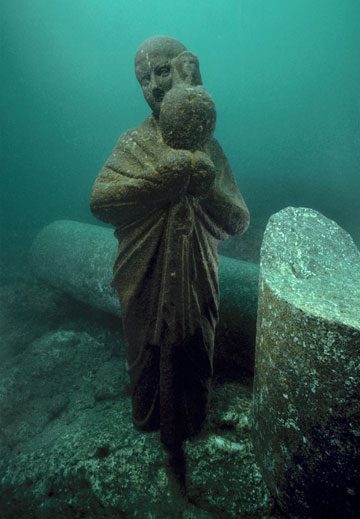
The first attempt to reveal the underwater history of these cities was undertaken by the Egyptian prince Omar Tousson in 1933 when a marble head of Alexander The Great was discovered near Minotes ..later the excavations came up with more discoveries like structures that once belonged to the temple of Isis.(Priest carrying an effigy of Osiris of Canopus found on the Antirhodos Island near the two sphinxes.©Franck Goddio/Hilti Foundation)

As for Canop Island( known now as the island of Nelson) dated to the 5th century B.C. to the 7th century A.C., Canop was a residential settlement and used as a stop point that supplied leaving ships with provisions .in this site a naval battle took place in 1798 between the French fleet and its rival the English, three ships sank and their wrecks were found in 1996-1997 located south east of the Island.

But there is an important question: How did the lighthouse wind up under water and all these sites?
(The lighthouse of Pharos )

From the fourth century until the 14th century there were earthquakes in Alexandria. In the Arab sources alone you have more than 20 mentions of earthquakes which affected the lighthouse. And we know that in the 14th century, after the Arabs had made some repairs to the lighthouse, the lighthouse collapsed due to very severe earthquakes.

There is a map in Montpelier, a town in southern France, which indicates that in 1303 the lighthouse of Alexandria was destroyed. In fact, there is an Arab traveler; his name is Ibn Battuta, who came to Alexandria in 1326 for the first time. And he writes, "I could have access to the door of the first floor of the lighthouse." And when he comes back to Alexandria in 1349, he says, "No access to this door. Everything here has collapsed." So in fact, in the first half of the 14th century that very strong earthquake put an end to this tower. This earthquake made the lighthouse collapse in a kind of line from the seashore.


(Next :Alexandria Submerged Antiquities in Egyptian museums)

8/09/2010

personage in Alexandria - Part 2


Prince Omar Tosson ( Egyptian politician & Archaeologist):
activist National, a thinker, a rich and a modest.he born On Sunday 8 September 1872, in Alexandria. Tosson was from the Sultan Muhammad Ali family,his grand father was Said Pasha.Toson was fond of research and exploration in the history of Egypt and Sudan, particularly in the area of the desert. ,he made So many trips to the Western Sahara.

One of the most discoveries his finding for the head of a statue of the Great Alexander in khaleg neama, and the discovery of remnants of the inundated city with water at a depth of five meters Abu Qir Bay in 1933,he has been published a research with photographs in the magazine of the Royal Society of Antiquities in (1934).


Sayed Darwish ( Egyptian composer):He was born in Kom Al-Dikka ,Alexandria on 17 March 1892, one of greatest Arabic composers&singers, his experience of working-class life makes his songs so powerful,his songs&his Egyptian voice expressed the internal anger of all Egypt against the occupation ,he was the voice of all Egyptians ,Darwish's output was prolific, including 26 musicals as well as about 260 songs.

The words of Egypt's national anthem were derived from one of Mustafa Kamel's best-known speeches, which Sayed Darwish set to music. He prepared a song for Saad Zaghlul's return from exile, but died before the nationalist leader's arrival.

According to Philippe Vigreux ("Centralité de la musique Egyptienne",Egypte/Monde arabe 7, 1991, CEDEJ), Darwish also played a crucial role in the adoption of Western techniques in writing music and the increased use of Western instruments, considered more capable of expressing emotion.He died in early age on 15th of September 1923 .and buried in Alexandria .


E(dward) M(organ) Forster ( English novelist):Edward Morgan Forster was born in London on 1 January 1879. He was English author and critic, he gained his fame as a novelist, Forster spent his 46 remaining years publishing mainly short stories and non-fiction. Of his five important novels four appeared before World War I,He worked for a while at the National Gallery then went to Alexandria in 1915 for join the Red Cross service during the the outbreak of world war I; his Alexandria: A History and a Guide was published in 1922 (almost the entire stock was burned) and reprinted in revised form in 1938. In Alexandria he met the Greek poet C.P. Cavafy, and published a selection of his poems in PHARAOS AND PHARILLON (1923).
"t
o win the respect of people whom I respect... I had better add that I am quite sure I am not a great novelist."..E.M. Forster..


Constantine Peter Cavafy ( Greek poet):

He was born in April 17, 1863 in Alexandria, His father is a wealthy businessman, founder of P. J. Cavafy and Co., an import-export business with offices in London and Alexandria. A prominent member of the Greek community, both he and Cavafy’s mother descend from the Greek upper class in Constantinople.


in 1872–77 his family moved to live in lthey left Alexandria for Liverpool and later London, Constantine attends school in England, where English becomes his primary language,in 1877–82: his family Returned to Alexandria. And set up their household on Ramleh Street. Cavafy continues his studies .

he was Greek poet who developed his own consciously individual style and he became one of the most important figures not only in Greek poetry but in Western poetry as well. He lived most of his life in Alexandria, loved English and French literature, and generally spoke English; even his Greek had a British accent.

Cavafy wrote much, publishing only about 200 poems. His most important poetry was written after his 40th year, and with some justification he called himself a "poet of old age." ,He is well-known to English readers from the many references to his work in Lawrence Durrell's Alexandria Quartet. Cavafy's poems were first published without date before World War II and reprinted in 1949. An English translation, The Poems of C.P. Cavafy, appeared in 1951…he died in April 29, 1933, Alexandria- Egypt.
and his house in Alexandria has been turned into a museum for the poet.


Mario Rossi ( Italian architect):

Italian-born Rossi (1897-1961) was one of the most prolific mosque builders the first half of this century. A student of the Scuela di Belle Arte in Rome, Rossi came to Egypt in 1921 as an assistant decorator at the invitation of Ernesto Verucci Bey when the latter was till Chief Court Architect and responsible for many of the changes and additions to Abdine Palace. Eventually, Rossi became his own master taking on individual assignments from the Ministry of Public Works as well as from Moustafa Fahmy who had taken over Verucci Bey's post. Another source of contracts was the Wakf Administration where Rossi became its Chief Architect.

Besides the mosque of Omar Makram, Rossi's other works include al-Fouli mosque in Minieh, Al-Ka'ed Ibrahim Mosque & Mursi abu il Abbas mosque in Alexandria, and the Zamalek mosque (across the Nile from the Balloon Theater). He also took part in the restoration of the Mohammad Ali mosque in the citadel and the Rifa'a mosque on Citadel Square.


Omar Sharif( Egyptian actor):

International film star whose exotic looks and soft-spoken manner made him something of a Gentleman symbol for years,Omar Sharif was born on 10th of April,1932..in Alexandria city….he studied mathematics and physics and worked in his family's lumber business before landing a part in an Egyptian film, beginning a career that would make him his country's top movie star.

It was the part of T. E. Lawrence's friend Ali in David Lean's epic Lawrence of Arabia (1962) that won him worldwide fame and snagged him an Oscar nomination for Best Supporting Actor. He followed with Lean's Doctor Zhivago (1965, at his most charismatic in the title role), More Than a Miracle (1967),and Che! (also 1969, in the title role), but his romantic appeal had waned by the 1970s and after starring performances in The Last Valley (1971),He has worked in TV, appearing in telefilms and miniseries.


Demis Roussos ( Greek singer) :

Date of birth 15 June 1947, he was born in Alexandria, and graduated in Greek school in Alexandria ,then his parents moved to live in Ismailiya..then he moved to live in USA.and became the most famous Greek singer .

8/08/2010

personage in Alexandria - Part 1


Many of important personages have passed by Alexandria , some were born in this land or lived here ,some of them just made their decision to spend the rest of their life in this great City.And here we share some of their achievements & unique touch they left on this city :


Alexander the great :

He was born on 356 B.C. He was born in Pella the ancient capital of Macedonia, he was the son of Philip II, king of Macedonia, His tutor was Aristotle, who trained him in literature and stimulated his interest in science, medicine and philosophy.


In the summer of 336 B.C. his father was assassinated and he ascended to the Macedainian throne,In 332 BC, Alexander of Macedonia, the Great, marched into Egypt , During his voyage to Zeus Ammon at the oasis of Siwa in the Libyan Desert, he stopped at a spot on opposite to the island of Pharos. ..he liked this spot and gave an order to the architect” Dinocrates of Rhodes”, to start founding his new city but he had no chance to see the town. He left before the first stone was laid, heading east to further victories and eventual death at Babylon “Iraq"…but Alexandria was named after the Macedonian general Alexander the Great…and he was buried in royal Soma(cemetery) in Alexandria(still his tomb is not found yet)


Cleopatra (69-30 BC), queen of Egypt (51-30 BC), celebrated for her love affairs with Julius Caesar and Mark Antony. In 51 BC, on the death of her father, King Ptolemy XII Auletes, Cleopatra and her brother Ptolemy XIII succeeded jointly to the throne. In the third year of their reign Ptolemy drove Cleopatra into exile. Roman general Julius Caesar arrived in Alexandria, became Cleopatra's lover, and returned her to the throne, after which Cleopatra lived in Rome as Caesar's mistress. After Caesar's assassination in 44 BC, Cleopatra returned to Egypt. Roman general Mark Antony then fell in love with Cleopatra and moved to Egypt. Later Antony returned to Rome, where he married Octavia, a sister of Caesar's heir, Octavian, later Emperor Augustus. When Antony went to the East as commander of an expedition against the Parthians in 36 BC, he and Cleopatra reunited. Following Antony's victory over the Parthians, Antony and Cleopatra lived in Egypt until 32 BC, when Octavian declared war against them. Following the Battle of Actium in 31 BC, Cleopatra and Antony fled to Alexandria, where they both committed suicide,wrongly Some historians titled Cleopatra’s reign as “ last pharaoh period”,but Cleopatra was not Pharaoh,she was Ptolemaic Queen and had no kinship with ancient Egyptian…although she kept on wearing as a pharaoh queen.


St. Mark: the traditional author of the second Synoptic Gospel, is said to have been preaching in Alexandria in the mid-1st century AD.St. Mark was a young man who grew up in a wealthy Jewish family. and they lived in Jerusalem. At an early age, Mark came under the influence of Christianity, and his home was often used as a meeting place for the early Christians.


In the very earliest years of the Church, there were no Church buildings like we have today. Because of persecution, and various state laws, Christians were often not allowed to meet in public. So they couldn't build their own buildings until around the year 250 - over 200 years after the Church had started. And so, they would often meet in various homes out of necessity, and St. Mark's home became one of these.

St. Mark later went on to travel with the Apostle Peter. He also wrote the first of the four Gospels that we have in the New Testament - the Gospel According to St. Mark. he moved to the city of Alexandria in Egypt, and that he was actually the first teacher of Christianity in Egypt.

On April 25, in the year 68 A.D., Mark was taken by a mob of people and dragged through the rocky streets of Alexandria until he died. He suffered much, and died as a martyr. His body was eventually sent to what is now the famous St. Mark's Church in Venice, Italy.


El-Mursi Abu-El-Abbas ( Spanish Muslim scholar) :

He was originally from Murcia, Spain, which was then part of the Islamic Empire. He settled down in Alexandria ,His mosque is the largest mosque in the city and it is distinguished for its high minaret and four domes. The mosque was originally built In 1775 by his Algerian students,it was built over the tomb of the thirteenth century Andalusan saint Ahmed Abu al-Abbas al-Mursi ,then in 1943 the mosque has been re-designed and rebuilt(by an Italian architect Mario Rossi) by adding 4 domes and the towering (73 meter) minaret..., The interior is made up of eight monolithic granite columns and a colonnade of elongated arches, the Mosque illustrates the sophistication of Andalusian Islamic architecture.

Churchill :
Churcill used to stay in the most famous hotels in Alexandria” the Cecil Hote” which was built in 1920,where Winston Churchill and Smerset Maugham have stayed. Also one of its suites was permanently reserved for the British Secret Service.,Inside the Cecil is Monty's Bar, named after Field Marshal Montgomery, a resident of the hotel during the desert campaign against Rommel.
Churchill mentioned that Alexandria has the best climate that he really enjoyed than in any other place he visited in the whole world.


Queen Sophia( Queen of Spain) :
She studied in the English Girls' College (EGC) in Alexandria's Shatby district ... Queen Sophia is the Honorary President of the Old EGCians.